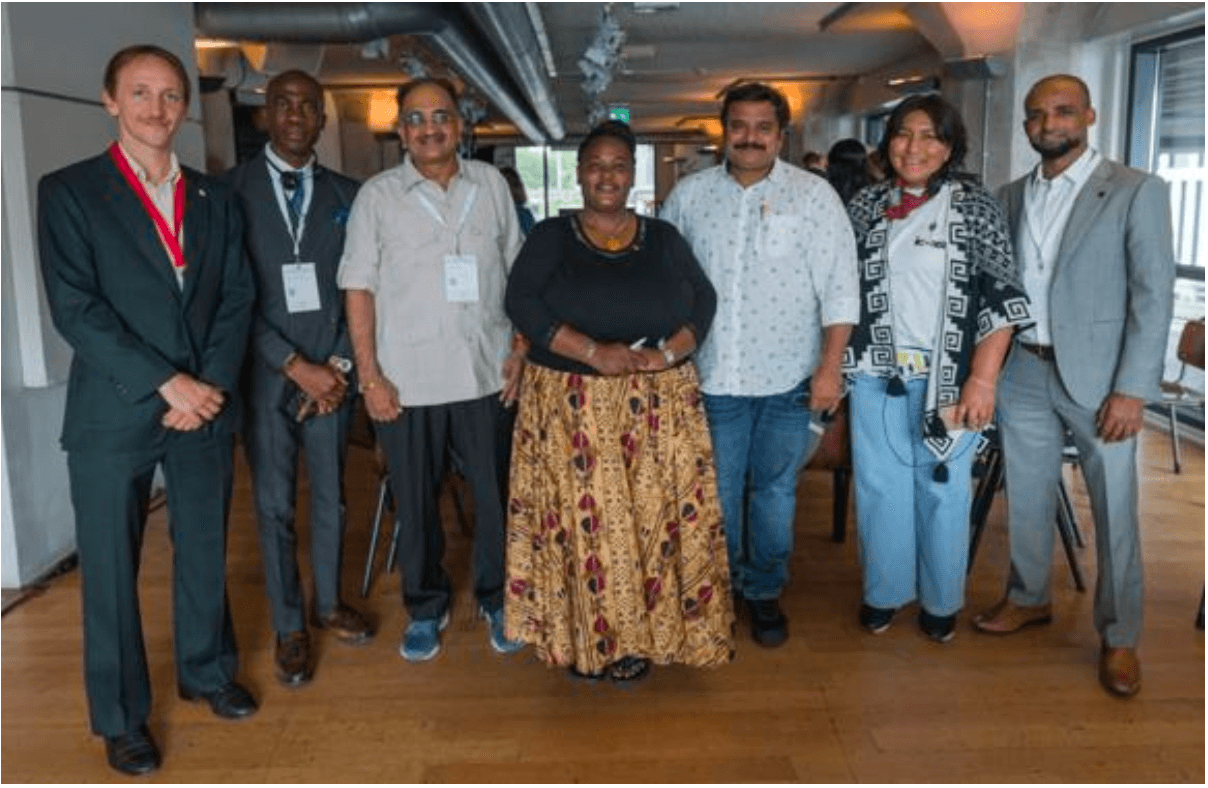
On 9 June 2026, the International Council for Artisanal and Small-Scale Mining (IC-ASM)
joined the 10th Anniversary Conference of the European Partnership for Responsible
Minerals (EPRM) in Amsterdam, bringing together ASM representatives Ms. Chiedza
Chipangura from Zimbabwe (Anglophone Africa), Mr. Bohoussou Kouakou Raymond from
Cote d’Ivoire (Francophone Africa), Dr Rana Sengupta on behalf of Mr. Nirmal Kachhawah
from India (South-Central Asia), and Ms. Sandra Isabel Bellido Perlacio from Peru (Latin
America).
The conference stood out for one simple reason: miners were not just being discussed, they
were leading the conversation. Too often, artisanal and small-scale miners are absent from
the rooms where their sector is debated. In Amsterdam, they were central participants,
sharing their experiences and priorities directly with governments, industry, development
partners, and civil society.
IC-ASM is grateful to the EPRM Secretariat for placing ASM workers at the center of the
event. It was a timely reminder that responsible mineral supply chains cannot be built without
the people who produce the minerals at source.
An opening speech that set the tone
The conference opened with a powerful address by Ms. Chiedza Chipangura, an artisanal
miner and ASM leader representing IC-ASM’s Anglophone Africa region.
Her message set the tone for the event:
“We are not a problem to be solved.”
“The question is not whether ASM is in the supply chain – it is how?”
“We are not here looking for charity, but to do business… looking for win-win partnerships.”
“If the world wants a responsible mineral supply chain, it has to bring us, the artisanal and
small-scale miners, into the room.”
The message was clear: ASM is already part of global mineral supply chains. The real
question is how markets, policies, and partnerships can better support responsible
production while improving livelihoods.
Meet the Miner
Building on this message, IC-ASM hosted a miner-centered session titled “Meet the Miner:
Co-creating Reliable and Responsible Mineral Value Chains.”
The session opened with short videos from mining communities in the four represented
regions, giving participants a direct view of mining realities, local initiatives, and the
challenges miners face every day. That grounded the discussion in lived experience before
the roundtables began.
Participants then moved into four “speed-date with a miner” tables, each led by an ASM
representative. The format created open, direct dialogue between upstream producers and
downstream actors, with a clear focus on practical collaboration.
The discussions centered on issues that matter most to responsible ASM, including:
• Mineral security and local value creation
• Supply chain transparency and traceability
• Responsible and ethical gold value chains
• Women’s leadership and entrepreneurship in ASM and mining-linked businesses
• Appropriate technologies for sustainable mining
• Fair, transparent, and long-term miner-buyer partnerships
South-Central Asia: A practical transition
One of the most constructive conversations came from the South-Central Asia table, led by
Dr. Rana Sengupta on behalf of Mr. Nirmal Kachhawah, IC-ASM representative for the
region. The discussion focused on the natural stone sector in Rajasthan, India, where a
large share of production is exported to European markets.